

A patient family perspective
Maria Bacon talks about her family’s journey with GM1
Maria Bacon waves as she drives past two teenagers on their bikes, loaded with fishing rods and bait, laughing as they cycle towards the river. In the small neighbourhood where she lives in Wisconsin, she recognises them as the childhood friends of her 17-year-old son, Joey. For any mother, such encounters are a reminder of the happiness and joy of family life – children growing up and exploring their neighbourhood together.
But for Maria, it was also another painful reminder that her son will never take part in these adventures. Like two of his siblings, Joseph (or Joey) has a rare genetic disease for which there is no treatment or cure, Juvenile GM1 (gangliosidosis). His condition caused him to lose the ability to cycle at the age of five. These days, instead of heading to the river with his friends, Joey’s daily routine involves taking medication and being washed, dressed and fed by his family.
In an interview with Azafaros to mark GM1 Day 2026, Maria discussed the challenges of having three boys with GM1 and the hope she has for the future of her children and other GM1 patients.
The day Joey was diagnosed was “truly heartbreaking”, recalled Maria.
“We knew something was going on but then you just think ‘I’ll just give him his treatment, or we’ll adjust this part of our lifestyle or get him this extra help and maybe he’ll have some struggles’,” she said.
“The idea of a disease with no treatment that was going to continuously and aggressively take everything from him until it eventually took his life? That was beyond the scope of what we could have even imagined. It took a long time to grieve that, and it still comes in spurts here and there.”
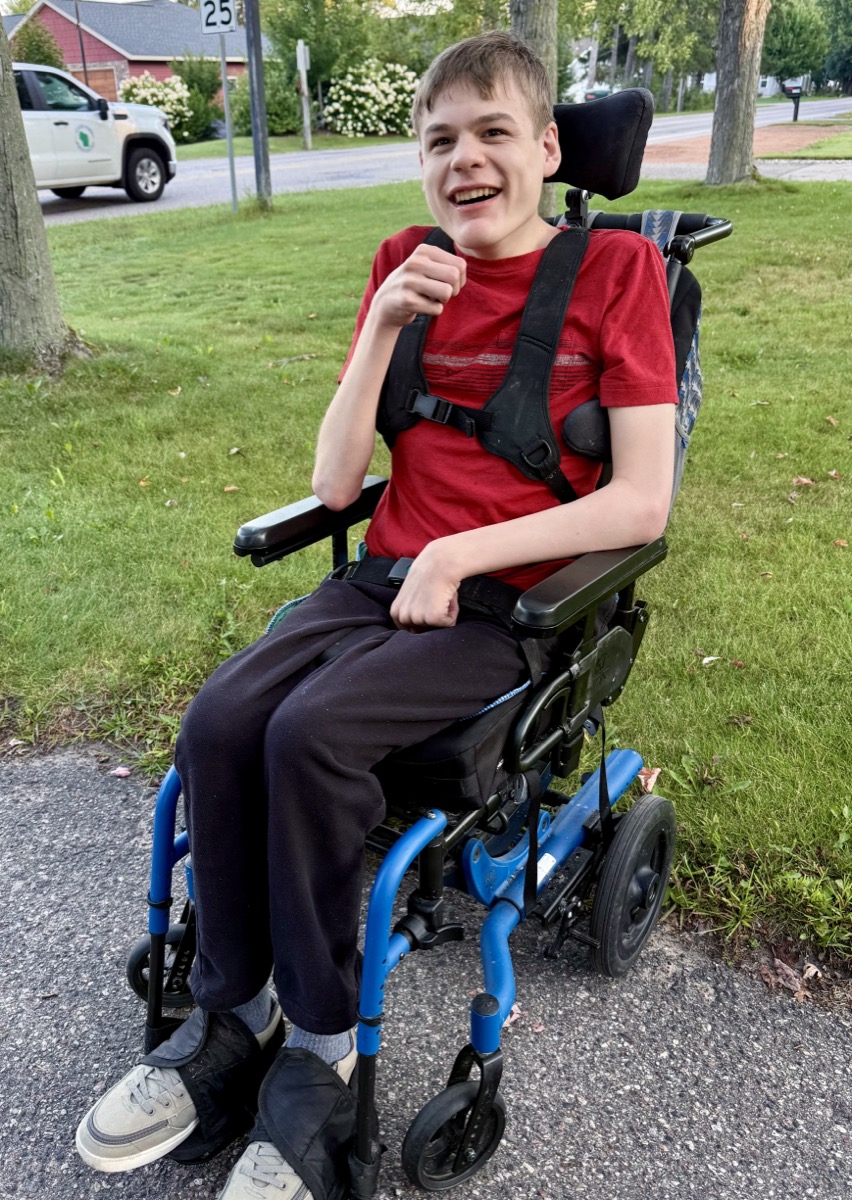 Joseph (Joey) Bacon, 17
Considering him to be a late bloomer, his parents, who had three older children who were developing at a regular rate, decided not to pursue an immediate investigation with doctors. However, at five and a half, Joey started to lose skills that he had already learned, including peddling a tricycle.
“Having not cycled all winter, we’d take out his bike again and he could no longer do it Aus,” explained Maria. “Over time, we would notice that he just wasn’t doing something he could do previously. He’d also wake up in the morning and say he was sick and then sleep all day, but he didn’t have any visible illness. The next day he’d be fine. This would happen about once a month.”
Maria and her husband Kevin began to look for answers, and over time this became a repeating pattern – visiting one doctor after another and coming home with no diagnosis, only being told Joey had “developmental delays” rather than something specific. The breakthrough came at the age of seven years old when a neurologist listened to his story and, suspecting seizures, referred him for a GM1 genetic test.
“I had no idea what a metabolic disease was. I’d never heard of it,” said Maria. “We did the tests and a few weeks later we got the GM1 diagnosis. Joey was around eight and a half, so it was around four years from the beginning of symptoms to diagnosis.”
This devastating news was made worse when the parents considered that their other children may also have GM1. Joey has three older siblings who were developing at a regular rate, so they decided not to test them. They also had a daughter who was a few years younger than Joey, and a son, Oliver, who was one year old. Both were asymptomatic. And while testing on both revealed that their daughter was negative, unfortunately Oliver was also diagnosed with Juvenile GM1.
 Oliver Bacon, 13
Luckily for the family, Oliver was able to receive gene therapy at age three, which they believe has helped. “It seems to have slowed the disease progression, but now he’s nine and he’s definitely got developmental delays, speech struggles and ADHD behaviours,” explained Maria.
Heartbreakingly, in addition to Joseph and Oliver, the couple received a positive GM1 diagnosis for their youngest child Dominic (now three) when he was just a few months old.
Since then, the parent’s lives have revolved around providing 24-hour care for their three boys, assisted by their 21-year-old son who still lives at home. Their daily routine involves doing everything for Joey, who can no longer talk and who is fully wheelchair bound, including giving him medication and feeding him. For the parents, it is especially important that Joey is still present at the family dinner table, even if he is sometimes fed through a tube to ensure he gets enough nutrition.
Despite the physical and mentally demanding routine, Maria maintains that the hardest aspect is the emotional side. “It’s hard to watch your kids lose their skills. When I saw those boys going out fishing, I feel that these are things which have been stolen from Joey.
“We’ve pretty much come to terms with the fact that we will be caregivers forever or as long as we are able to. It’s a little overwhelming, especially as we worry about what happens to the boys once we are physically unable to care for them. Who could do a better job?”
 Dominic Bacon, 3
“When a family is first diagnosed, it’s really overwhelming. It’s hard to take in all the information and figure out what to do with it.”
Despite her daily challenges with GM1, Maria maintains that she is very proud of her family and remains hopeful for the future.
“I am looking forward to the day when families who receive a diagnosis of GM1 don’t hear the words ‘there’s nothing we can do’. My hope is for parents to receive the diagnosis early while their child is still high functioning, and then the doctor says to them ‘ok here are your treatment options’”.